











Credit Card Fees for Merchants: the Complete Guide
Every card transaction carries three separate costs, not one: the interchange fee kept by the cardholder's bank, the scheme fee collected by the network (Visa or Mastercard), and the markup charged by your payment provider. Most quotes merchants receive show a single blended percentage instead of separating these three components, which makes it nearly impossible to compare two offers fairly. This guide explains what actually makes up a credit card fee, compares the IC++, blended, and flat rate pricing models, and links every deep-dive article on interchange, scheme fees, acquirer markup, and currency conversion.
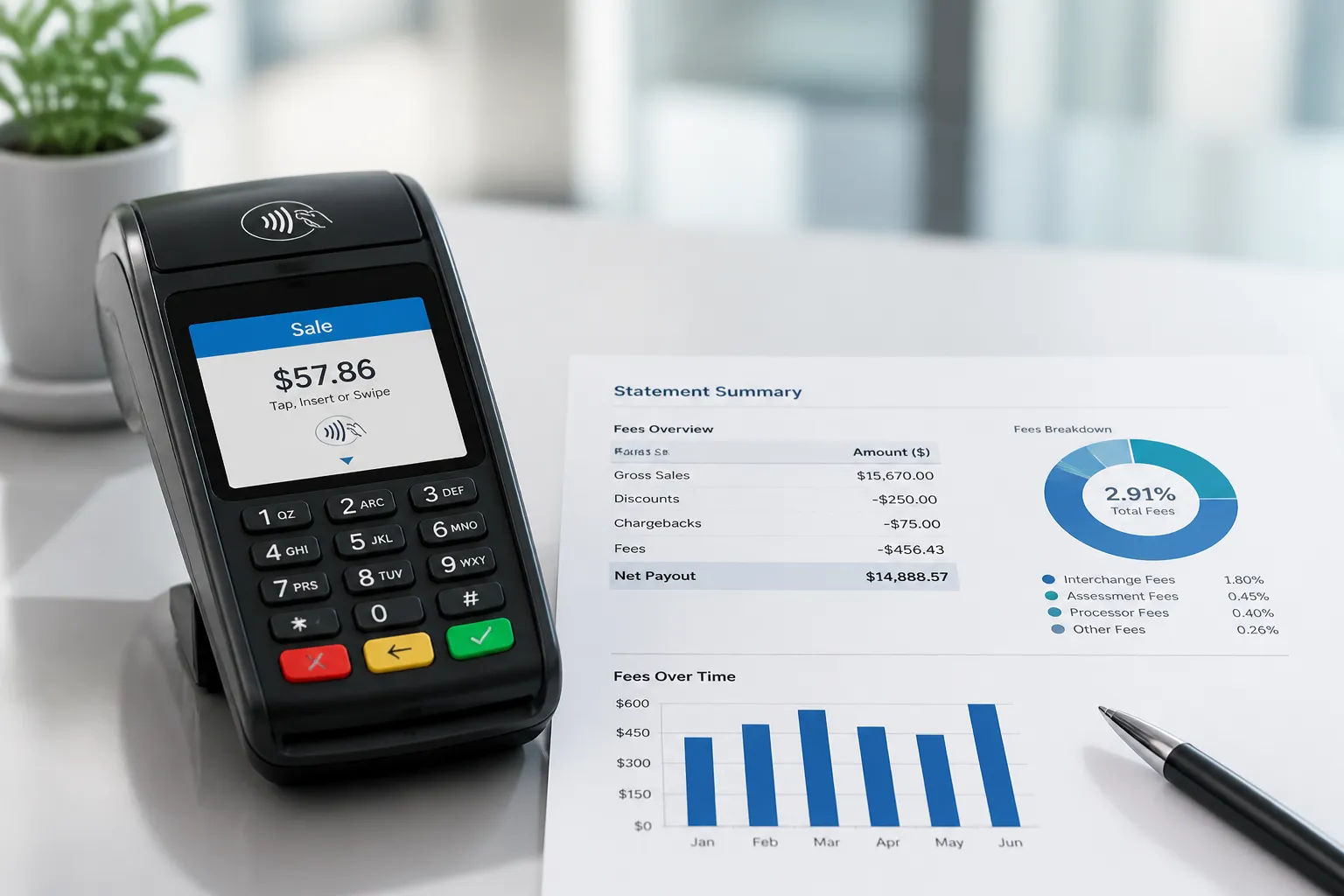
Pricing models compared: IC++ vs Blended vs Flat Rate
| Model | How it works | Transparency |
|---|---|---|
| IC++ (RoxPay) | Interchange (set by Visa/Mastercard) + scheme fee (set by the network) + RoxPay markup shown separately: €0.15 + from 0.35% to 0.85% | Every component visible on the statement |
| Blended | A single flat percentage on every transaction, regardless of card type or channel | Interchange, scheme fee, and provider markup cannot be told apart |
| Flat rate | An advertised flat percentage (e.g. 1.4-1.9%) often paired with undisclosed monthly fees or PCI costs | Low: the real cost usually exceeds the advertised headline rate |
IC++ is the only model that shows interchange, scheme fee, and provider markup separately on every single transaction.
What actually makes up a credit card fee
Every card fee splits into three distinct layers, each paid to a different party in the payment chain.
Interchange fee: paid to the customer's card-issuing bank. In the EU it is capped under the IFR Regulation at 0.20% for consumer debit cards and 0.30% for consumer credit cards; commercial cards and cards issued outside the EEA are not subject to this cap and can cost considerably more. The full rate comparison for both major networks is in our [Mastercard interchange fees guide](/en/resources/mastercard-interchange-fees-eu) and [Visa interchange fees guide](/en/resources/visa-interchange-fees-eu).
Scheme fee: paid to the network (Visa or Mastercard) for using its infrastructure. It's an almost invisible line item, typically between 0.10% and 0.15% of the transaction plus a small fixed amount in cents, but unavoidable: no merchant, however large, can opt out of it while accepting that network. Covered in detail in our [scheme fees guide](/en/resources/scheme-fees-hidden-credit-card-costs).
Acquirer markup: your payment provider's margin, and the only one of the three that is actually negotiable. On blended or flat rate pricing this markup is hidden inside the single percentage; on IC++ it's a separate, visible line.
IC++ vs Blended vs Flat Rate: the difference that actually matters
On blended pricing, your provider applies the same percentage to a consumer debit card with 0.20% interchange and to a commercial card with interchange above 1%, pocketing a much higher margin on the first category without it ever showing on your statement. With IC++, every transaction shows separately what goes to the issuing bank, what goes to the network, and what stays with the provider: if your card mix is mostly EU consumer debit cards, IC++ typically costs less than an equivalent blended rate, because you stop subsidising the cost of other merchants' more expensive cards.
Flat rate pricing, often advertised with a low single percentage (e.g. 1.4%), in practice tends to hide monthly fees, activation costs, or PCI charges that only surface once you read the full contract: the headline percentage is rarely the actual total cost.
The RoxPay model: transparent IC++ pricing
RoxPay applies IC++ across both standard and high risk merchant categories: €0.15 + from 0.35% to 0.85% (IC++), with the RoxPay markup always shown separately from interchange and the scheme fee. The exact markup for your business is set based on volume, sector, and processing history, and stays visible line by line on every settlement statement.
For a full worked example with a real transaction broken down line by line (interchange plus scheme fee plus markup), see our [IC++ fee calculation guide](/en/resources/calculating-payment-fees-ic-plus-plus).
What else changes the final fee
Beyond interchange, scheme fees, and markup, two more factors affect the real cost of a transaction.
Acquiring bank markup: some providers add a further hidden markup on the acquiring bank side, distinct from the gateway's own markup: our [acquiring bank markup guide](/en/resources/acquiring-bank-markup-fees) explains how to spot it inside a contract.
Currency conversion (FX): if you accept payments in currencies other than your settlement currency, a conversion cost applies that varies significantly between providers and rarely appears in the advertised headline rate: details in our [currency conversion costs guide](/en/resources/fx-currency-conversion-costs-online-payments).
For a direct comparison of fees across multiple payment gateways on these same criteria, see our [payment gateway fees comparison](/en/resources/payment-gateway-fees-comparison).
How to reduce your business's credit card fees
Before renewing your current contract or signing a new one, check these concrete points to find out whether you're really paying the minimum necessary.
Frequently Asked Questions
What exactly are credit card fees for a merchant?
They are three separate costs charged on every transaction: the interchange fee to the card-issuing bank, the scheme fee to the network (Visa or Mastercard), and the markup to your own payment provider. Only the markup is genuinely negotiable; interchange and scheme fees are set by the networks and identical across every provider operating in the same market.
What's the difference between interchange fee, scheme fee, and markup?
The interchange fee goes to the bank that issued the customer's card and is capped in the EU under the IFR Regulation (0.20% debit, 0.30% credit for consumer cards). The scheme fee goes to the network for using its infrastructure and typically runs between 0.10% and 0.15% plus a small fixed amount. The markup stays with your payment provider and is the component you can actually negotiate, since it reflects their margin and their assessment of your business's risk.
Does IC++ pricing always cost less than blended?
Not always in absolute terms, but almost always for a merchant whose card mix is mostly EU consumer debit cards, because IC++ doesn't charge a margin averaged across every card category. A merchant that receives mostly commercial or non-EU cards, which carry higher interchange, may see less of a gap between the two models: the only way to know for certain is to request the separate breakdown of all three components against your own real processing history.
What's the average cost of accepting credit card payments in Europe?
For EU-issued consumer credit cards, the theoretical minimum cost is around 0.30% interchange plus 0.10-0.15% scheme fee, so roughly 0.40-0.45% before the provider's markup. The real total cost, markup included, typically ranges from about 0.7% to 2% on IC++ depending on sector and volume, while a blended rate for the same risk profile is often quoted higher because it bakes in a margin averaged across every card category.
What changes with commercial cards or cards issued outside the EU?
Commercial cards (Business, Corporate, Purchasing) and cards issued outside the European Economic Area are not subject to the IFR cap: interchange can exceed 1-2% instead of the 0.20-0.30% that applies to EU consumer cards. If a meaningful share of your customers pay with commercial or international cards, your average transaction cost will be higher regardless of provider, which makes seeing the separate breakdown by card category even more important than relying on a single average percentage.
How do I calculate the real cost of my credit card fees?
Pull your latest processing statement and check whether interchange, scheme fee, and markup are shown separately for each transaction: if they are, you can calculate a true weighted average cost against your actual card mix. If your statement only shows a single percentage per transaction, you have no way to verify how much of that is the provider's margin versus the fixed network costs: our [IC++ fee calculation guide](/en/resources/calculating-payment-fees-ic-plus-plus) walks through a full line-by-line worked example.
You might also like
High Risk Payment Gateway
Secure payment processing for high-risk industries with multi-acquirer routing and chargeback protection.
Small Business Payment Solutions
Transparent IC++ pricing, free Smart POS terminal, and 24-hour activation for small businesses.
E-commerce Payment Integrations
One-click plugins for WooCommerce, Magento, and PrestaShop with full API access.
Optimize your payments today
Calculate how much your business can save with RoxPay's IC++ pricing compared to a flat percentage rate. Talk to an expert at /en/contact.
✓ No monthly fixed costs · ✓ Activation in 24 hours · ✓ Dedicated technical support