











Mandatory POS in Italy: Regulations, Fines, and 2026 News
The obligation to accept electronic payments via POS has existed in Italy since 2014, but it only became truly punishable on June 30, 2022, with a fixed fine of 30 euros plus 4% of the value of the refused transaction. From January 1, 2026, a second distinct obligation is added: the administrative connection between the POS terminal and the telematic recorder via the Revenue Agency's Invoices and Fees portal. This guide explains who must comply with the obligation, what the risks are in case of violation, what changes with the 2026 news, and how to choose a POS terminal that allows you to stay compliant without operational complications.
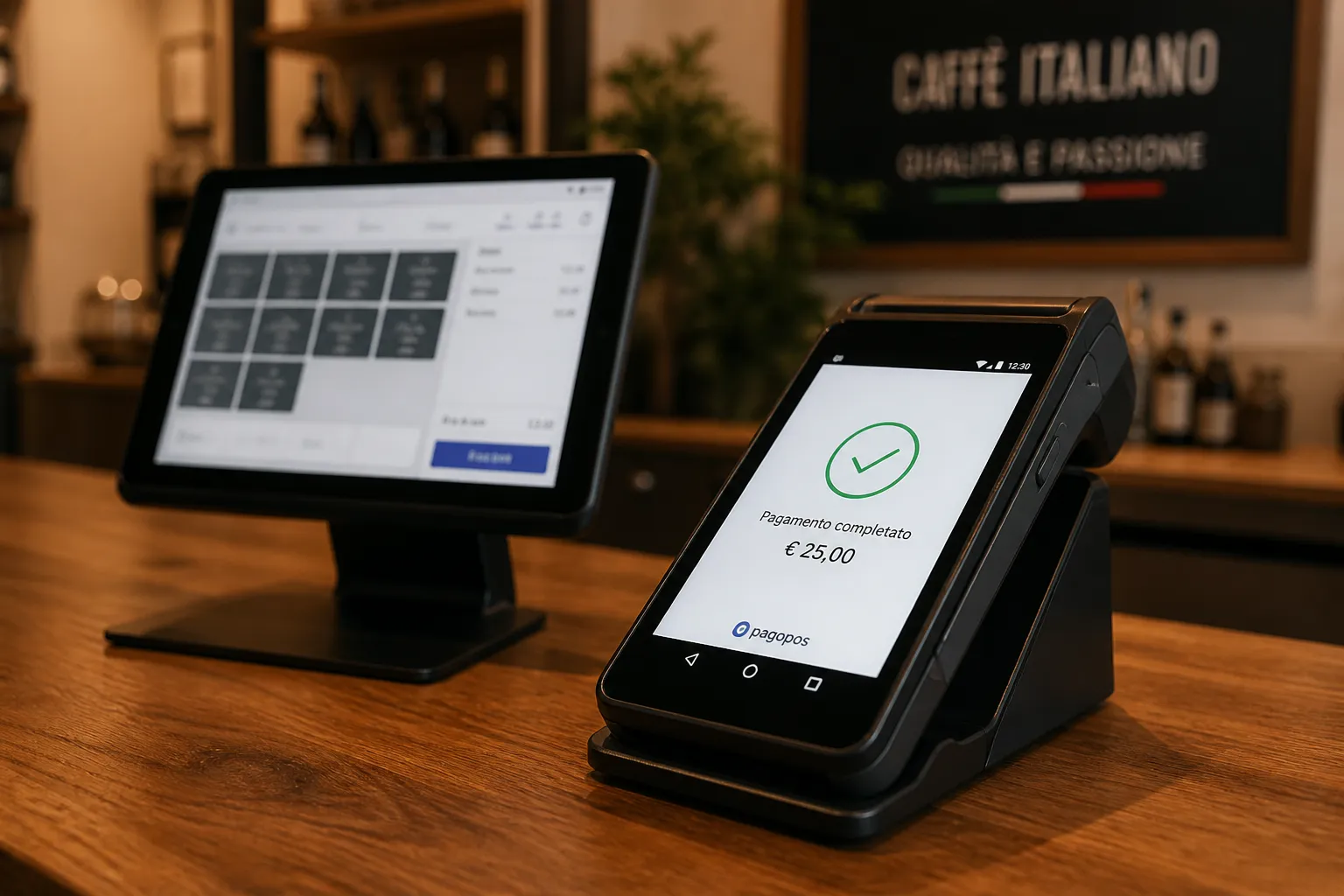
What is the POS obligation and who must comply with it
The obligation to accept payments with debit cards, credit cards, and prepaid cards is established by Article 15, paragraph 4, of Decree-Law 179/2012 (converted into Law 221/2012), in force since June 30, 2014. The rule applies to anyone selling products or providing services, including professionals: shops, bars, restaurants, but also professionals such as doctors, lawyers, and engineers, as well as mobile activities like taxis.
The obligation does not depend on owning a premises open to the public or on a minimum transaction amount: it applies regardless of the payment value requested from the customer, even for amounts of a few euros. The obligation covers both in-person payments via physical terminals and remote collections via payment links or software platforms, because the law generically speaks of "electronic payment instruments" and not just physical POS: an ecommerce that exclusively accepts cash on delivery, for example, still does not comply with the obligation.
Fines for failure to use the POS: what are the risks
For years the POS obligation remained without a specific applicable penalty, until Decree-Law 36/2022 (implementing the NRRP) brought forward the entry into force of the penalties from January 1, 2023, to June 30, 2022. Since that date, Article 15, paragraph 4-bis, of Decree-Law 179/2012 provides for an administrative fine consisting of a fixed quota of 30 euros plus a variable quota equal to 4% of the transaction value for which the electronic payment was refused.
Unlike many other administrative fines, this violation is not subject to obliteration: it is therefore not possible to close the dispute by paying a third of the maximum within 60 days, as provided instead by Law 689/1981 for other infractions. The only recognized exclusion is the objective technical impossibility of accepting the payment, for example, a documented malfunction of the POS terminal.
The 2026 news: the mandatory connection between POS and telematic recorder
From January 1, 2026, a second obligation applies, distinct from that of accepting payments: the 2025 Budget Law (Law 207/2024, paragraph 74), which amends Article 2, paragraph 3, of Legislative Decree 127/2015, requires the administrative connection between each POS terminal and the telematic recorder (RT) or the online Commercial Document web procedure used to certify fees. This is not a physical or technical connection between the two devices: it is a pairing that the merchant registers online between the telematic recorder's serial number and the POS identification data.
The Revenue Agency activated the dedicated web service on March 5, 2026, in the reserved area of the Invoices and Fees portal. For POS already active on January 1, 2026 (or used in the month of January), the deadline for the first communication was set for April 20, 2026; for terminals activated subsequently, the association must be carried out between the sixth and the last day of the second month following activation.
What happens if you do not connect the POS and telematic recorder in time
Failure to connect the POS and telematic recorder within the established deadlines is equated by law to a failure to memorize the fees. The penalties provided for by Legislative Decree 471/1997, as amended by the 2025 Budget Law, include a fine equal to 90% of the VAT due on the undocumented transaction, with a minimum of 500 euros for each contested violation. In case of recidivism, with four distinct violations contested on different days over five years, the suspension of the activity from 15 days to 2 months is expected; if the amount of undocumented fees exceeds 50,000 euros, the forced closure can last up to 6 months.
This second obligation applies to all merchants who use a telematic recorder and accept electronic payments, regardless of the sector of activity.
Who is exempt from the POS obligation: exceptions and false myths
A common doubt concerns a presumed minimum threshold below which the POS would not be mandatory, often cited as 5 or 10 euros. There is no such threshold in the legislation: the fine applies regardless of the amount of the refused transaction, even for payments of a few euros. The only exclusion recognized by the law is the objective technical impossibility of accepting electronic payment, which must be documented case by case (for example, a verifiable terminal failure), not simply declared to the customer at the time of payment.
Those who have doubts about their specific case should verify the situation with a tax consultant, because the burden of proving technical impossibility falls on the merchant in case of a check.
Another frequent doubt concerns professionals under the flat-rate tax scheme: the law does not provide for any exemption linked to the tax regime adopted. Whether the business invoices one thousand euros or one million euros a year, the obligation to accept electronic payments remains the same, because the law links it to the type of activity carried out (sale of products or provision of services), not to the turnover volume or the accounting regime applied.
How to choose the right terminal to stay compliant
Staying compliant with both obligations requires a POS terminal that accepts electronic payments reliably and a provider capable of supporting the administrative connection with the telematic recorder without complications for the merchant. Before choosing a provider, it is worth comparing the pricing model, crediting times, and fixed fees in our [complete guide on how to choose a payment gateway](/en/resources/how-to-choose-a-payment-gateway-guide), which collects the evaluation criteria also used for physical terminals.
For hardware only, the [guide to Android POS terminals](/en/resources/android-pos-terminal) compares the features of the most common models, while the [guide to POS costs](/en/resources/pos-costs-fees-commissions-hidden-charges) delves into monthly fees and hidden costs to check before signing a contract. Those evaluating whether it is better to rent or buy the terminal can consult the [guide to renting vs buying POS](/en/resources/pos-rent-vs-buy-which-is-better). RoxPay applies a transparent IC++ pricing (€0.15 + from 0.35% to 0.85% (IC++)), with no fixed monthly fee, on POS terminals provided to Italian merchants.
Frequently Asked Questions
Since when has the POS been mandatory in Italy?
The obligation to accept payments with debit cards, credit cards, and prepaid cards has been in force since June 30, 2014 (Article 15, paragraph 4, of Decree-Law 179/2012). The penalties for those who refuse electronic payment only became applicable from June 30, 2022, after Decree-Law 36/2022 brought forward the date originally set for January 1, 2023.
What are the penalties for those who do not accept POS payments?
The administrative fine provided for by Article 15, paragraph 4-bis, of Decree-Law 179/2012 consists of a fixed quota of 30 euros plus a variable quota equal to 4% of the value of the refused transaction, regardless of the amount. This violation does not allow the administrative obliteration provided for other infractions by Law 689/1981.
Is it true that below a certain threshold the POS is not mandatory?
No. There is no minimum amount threshold below which the POS obligation does not apply: the fine can be imposed even for the refusal of an electronic payment of a few euros. The only recognized exclusion is the objective technical impossibility of accepting the payment, to be documented on a case-by-case basis.
What is the new obligation to connect POS and telematic recorder from 2026?
From January 1, 2026, the 2025 Budget Law (Law 207/2024) requires that each POS be administratively paired with the merchant's telematic recorder via the Revenue Agency's Invoices and Fees portal. It is not a physical connection between the devices: it is an online registration that associates the telematic recorder's serial number with the POS identification data.
What happens if you do not connect the POS and telematic recorder by the deadlines?
Failure to connect is equated to a failure to memorize fees: the expected fine is equal to 90% of the VAT due on the undocumented transaction, with a minimum of 500 euros per violation. In the event of four distinct violations in five years, the business risks suspension from 15 days to 2 months.
What activities are exempt from the POS obligation?
The only exclusion provided by the legislation concerns cases of objective technical impossibility to accept electronic payment, for example, a documented terminal failure. There are no generic exclusions by sector, business size, or transaction amount: always verify your specific case with a tax consultant if you have doubts.
You might also like
High Risk Payment Gateway
Secure payment processing for high-risk industries with multi-acquirer routing and chargeback protection.
Small Business Payment Solutions
Transparent IC++ pricing, free Smart POS terminal, and 24-hour activation for small businesses.
E-commerce Payment Integrations
One-click plugins for WooCommerce, Magento, and PrestaShop with full API access.
Optimize your payments today
Discover the RoxPay POS for your business. No fixed monthly costs, transparent IC++ pricing. Contact us at /en/contact.
✓ No monthly fixed costs · ✓ Activation in 24 hours · ✓ Dedicated technical support