











Chargeback: What It Is, How It Works, and What to Do as a Merchant
A chargeback is the forced reversal of an already-collected payment, initiated by the cardholder's bank rather than by the merchant. Unlike a refund, which starts from the merchant's own decision, a chargeback is imposed by the card scheme (Visa or Mastercard) at the cardholder's request, and for the merchant it almost always means an immediate loss of funds plus a fixed fee. This guide explains what a chargeback is, how it works differently for card-present POS payments versus online payments, what it costs, the real timelines involved, and what to do when you receive one to maximise your chances of recovering the funds.
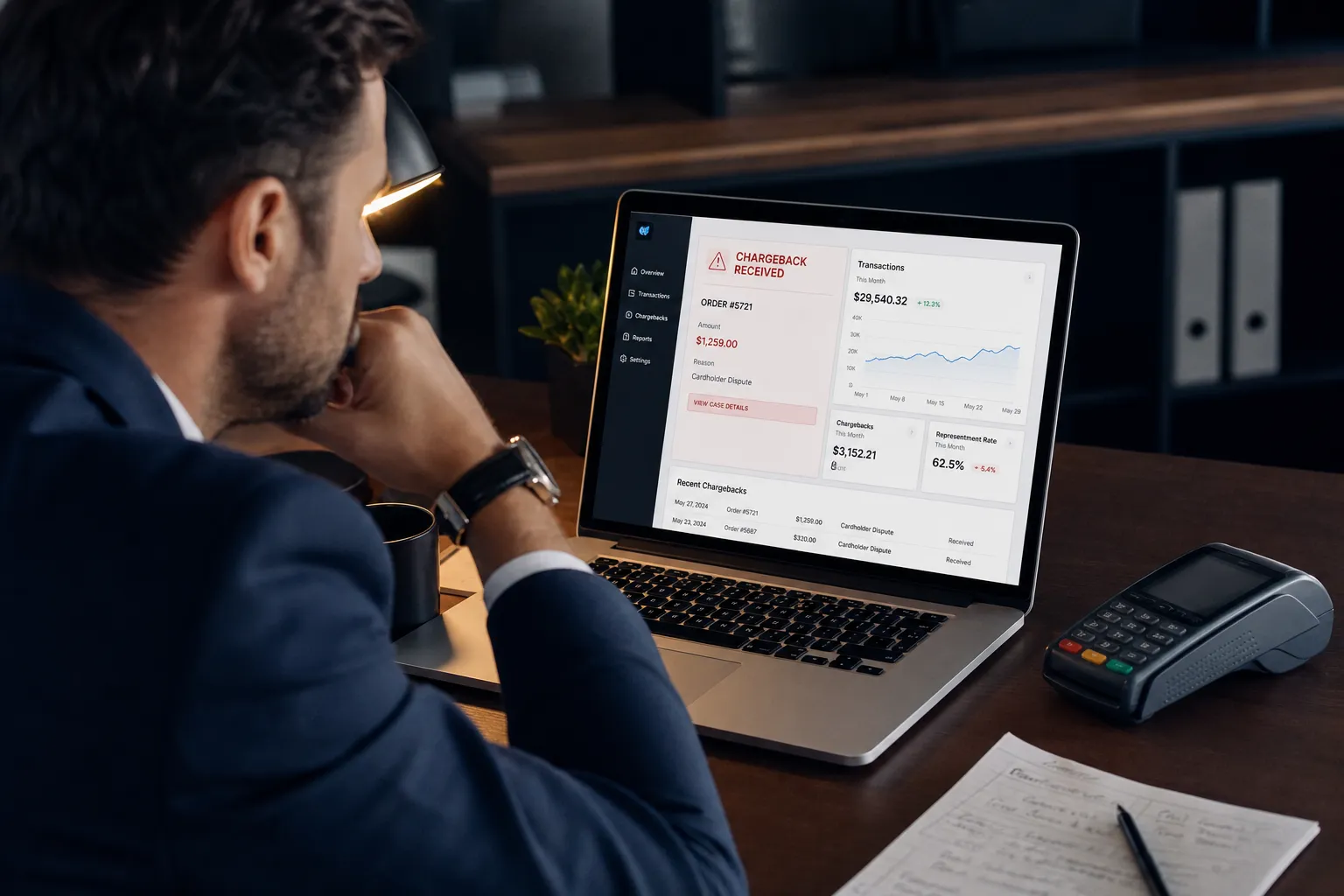
What a chargeback is and how it differs from a refund
A chargeback is a transaction that has already been credited to the merchant's account but gets forcibly reversed because the cardholder disputed the charge with their own bank.
The difference from a refund is substantial. A refund is a voluntary action: the merchant decides to return the money to the customer, for example after a return, and stays in control of the timing and amount. A chargeback is imposed from the outside: the cardholder's bank provisionally credits the amount back to the cardholder and debits it from the merchant, who then has a limited window to dispute the decision by submitting evidence.
For the merchant, a chargeback typically means losing the transaction amount, paying a fixed handling fee (15-30€ regardless of the outcome), and a worse "chargeback ratio", the ratio between disputed and total transactions monitored by Visa and Mastercard. If this ratio goes above 1% of monthly transactions, the merchant enters monitoring programmes with escalating financial penalties and, in the most serious cases, the revocation of card acceptance privileges.
How chargebacks work for card-present POS payments versus online sales
The likelihood of receiving, and losing, a chargeback changes significantly depending on the payment channel. On a card-present POS transaction with a chip card authenticated by PIN, liability for a fraud dispute almost always falls on the card issuer rather than the merchant: this is the "liability shift" principle introduced with the EMV migration, which protects the merchant when the payment was correctly authenticated at the time of the transaction.
The risk for card-present merchants increases in cases without PIN entry (contactless above the floor limit with a signature), manual card number entry (key entry, for example for phone orders), or when the terminal fails to properly record the receipt and proof of delivery of the goods or service. In these scenarios, the burden of proof shifts back to the merchant, who must keep the signed receipt and any documentation useful to prove the transaction was legitimate.
For an online store the situation is structurally more exposed, because the card is not physically present: the merchant has to rely on indirect evidence such as IP address, AVS/CVV match, and 3D Secure authentication to prove the transaction was legitimate, as explained in our full guide to the chargeback dispute process. A merchant selling both in-store and online therefore faces two different risk profiles, with equally different prevention strategies for each channel.
Timelines and who pays the chargeback fee
Card scheme rules give the cardholder a wide window to dispute a charge: up to four months (120 days) from the payment date, or from the expected delivery date if the goods never arrived. A sale processed today can therefore still be disputed well into the following year, a timeframe many merchants underestimate when deciding how long to keep receipts and proof of delivery: the correct answer is at least six months.
Once a chargeback is initiated, the merchant has on average 7-20 calendar days to respond with evidence, depending on the acquirer and card scheme involved. Missing this window results in automatic loss of the dispute, regardless of how strong the evidence would have been.
The chargeback handling fee, typically between 15 and 30€, is charged to the merchant regardless of the outcome: even if the merchant wins and recovers the transaction amount, the fixed fee is almost never refunded. If the merchant disputes the bank's decision after already receiving an unfavourable outcome, the case can be escalated to card scheme arbitration, a further step that costs several hundred euros and is only worth pursuing for high-value disputes backed by very solid evidence.
What to do when you receive a chargeback notification
Ignoring a chargeback notification results in automatic loss of the dispute: the funds stay debited permanently, the fee is charged anyway, and the case counts against the merchant's chargeback ratio. Responding on time, even with partial evidence, is always better than not responding at all.
Chargebacks on recurring payments and subscriptions
Businesses that bill through recurring charges (subscriptions, monthly fees, memberships) face a different chargeback profile than those selling a one-off product. A customer who forgets they signed up for a subscription, or who cannot easily find how to cancel it, tends to contact their bank instead of the merchant, filing a chargeback for "recurring transaction not recognised" or "subscription cancelled but still charged".
For this type of merchant, two measures significantly reduce the number of chargebacks received: an easily reachable self-service cancellation flow on the website or app, and a reminder email sent a few days before every automatic renewal. A customer who can cancel on their own, or who is warned ahead of the next charge, has one less reason to go straight to their bank.
How to prevent chargebacks before they happen
Prevention remains more effective and cheaper than disputing after the fact: a chargeback that is never received costs nothing in time, fees, or impact on the chargeback ratio. On card-present POS, favouring chip-and-PIN authenticated transactions over PIN-less contactless reduces the merchant's exposure to fraud cases. A clear billing descriptor (the name that appears on the customer's statement) prevents the customer from not recognising the charge and filing a chargeback by mistake, a common scenario when the company's legal name differs from the shop's trading name.
For online sales, 3D Secure 2.0 authentication shifts liability for the authenticated transaction to the cardholder's bank, making it much harder for the cardholder to successfully dispute a legitimate charge. The full prevention strategies, including techniques for spotting friendly fraud before it becomes a formal chargeback, are in our guide on how to reduce chargebacks. A merchant selling both in-store and online should apply both strategies in parallel, because the two channels generate different types of chargebacks that do not rule each other out.
Frequently Asked Questions
Who pays the chargeback fee, the customer or the merchant?
The chargeback handling fee, typically between 15 and 30€, is always charged to the merchant, regardless of who is in the right. Even if the merchant wins the dispute and recovers the transaction amount, the fixed fee is almost never refundable.
Can a chargeback arrive months after the payment?
Yes, up to around four months later. Card schemes give the cardholder a 120-day window to dispute a charge, counted from the payment date or from the expected delivery date if the product never arrived. That is why receipts, proof of delivery, and transaction logs should be kept for at least six months after every sale.
How can I reduce chargebacks on my POS or online store?
For card-present POS, always favour chip-and-PIN authenticated transactions, which shift fraud liability to the card issuer. For online sales, enable 3D Secure 2.0, use a recognisable billing descriptor, and keep detailed proof of delivery: the full strategies are in our guide on how to reduce chargebacks.
Is a chargeback the same thing as a dispute?
Yes, "dispute" and "chargeback" describe the same mechanism at different stages: the cardholder files a dispute with their bank, which the bank then processes as a chargeback against the merchant. The process, timelines, and card scheme rules are identical either way.
Does a chargeback affect my ability to accept cards in future?
A single, isolated chargeback has no practical consequences. The problem starts when the ratio of chargebacks to total transactions approaches or exceeds 1% per month: at that point Visa and Mastercard monitoring programmes kick in, with financial penalties that increase over time and, if the ratio does not improve, possible revocation of card acceptance privileges by the acquirer.
You might also like
High Risk Payment Gateway
Secure payment processing for high-risk industries with multi-acquirer routing and chargeback protection.
Small Business Payment Solutions
Transparent IC++ pricing, free Smart POS terminal, and 24-hour activation for small businesses.
E-commerce Payment Integrations
One-click plugins for WooCommerce, Magento, and PrestaShop with full API access.
Optimize your payments today
Reduce chargebacks with RoxPay's dispute management. Find out how at /en/contact.
✓ No monthly fixed costs · ✓ Activation in 24 hours · ✓ Dedicated technical support