











Card Machine for Small Business UK: Costs and How to Choose
A card machine for small business UK plans split into three costs: hardware, a possible monthly fee and the transaction rate. Entry readers start at 15 to 25 pounds on SumUp's current list, and typical blended rates sit between 1.4% and 1.75%. This guide compares machine types, fees and contracts so a small business pays only what it should.
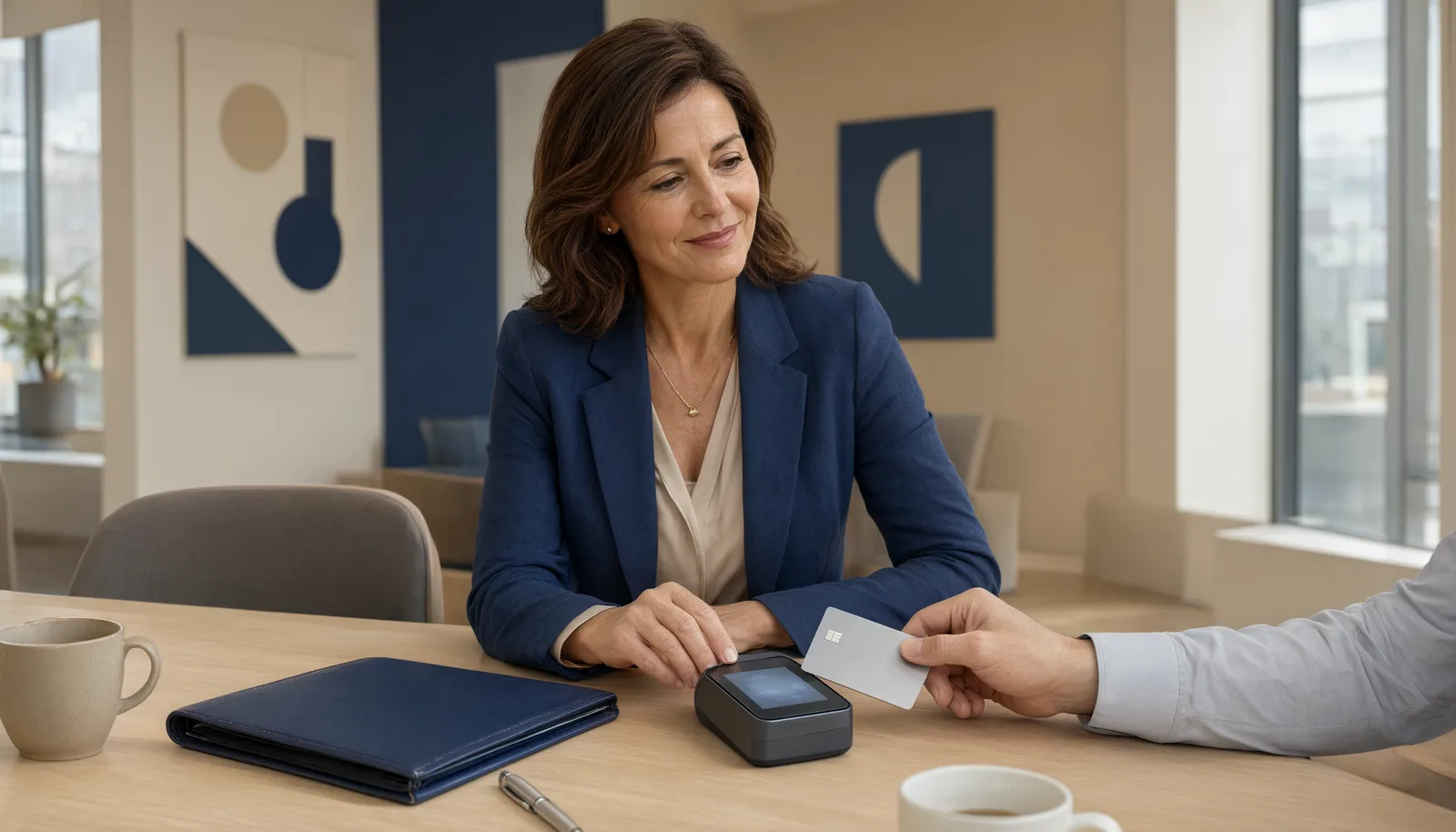
Which card machine type fits a small business
UK providers group machines into four families. Countertop: wired to the till network, built for fixed counters with steady footfall. Portable: connects over Bluetooth or Wi-Fi, lets staff take payment at the table or across the shop. Mobile: carries its own SIM, made for trades, markets and deliveries. SoftPOS: an app turns the merchant's NFC phone into the terminal, with no hardware at all.
The choice follows two numbers: card takings per month and average ticket. Under roughly ten card sales a month, SoftPOS is usually enough; a cafe or salon taking dozens of daily payments gains from a dedicated machine with a guaranteed battery and printed or digital receipts.
What a card machine costs in the UK
Hardware is the small part. Entry readers such as SumUp's are listed from 15 to 25 pounds, full touchscreen terminals like Square Terminal or Zettle's newer readers sit higher on the price list, and some acquirers still rent machines at 15 to 40 pounds per month.
The recurring part matters more. Blended pricing, used by SumUp at 1.95% and Square at 1.75% on their public lists, bundles interchange, scheme fees and provider margin into one opaque percentage. With itemised IC++ pricing every component is visible: RoxPay charges €0.15 + 0.35% to 0.85% (IC++). Because no interchange cap applies to UK acquiring since Brexit, an itemised statement is the only way to see the real cost of each card type. The [guide to POS costs, fees and hidden charges](/en/resources/pos-costs-fees-commissions-hidden-charges) breaks the three blocks down with worked examples.
Transaction fees on small tickets
On a 3 pound coffee, the fixed element of a fee weighs more than the percentage. That is why the same tariff produces very different effective costs across a small business's month: contactless sales between 2 and 20 pounds, table bills above 30 pounds, occasional B2B invoices on premium cards.
The fair comparison runs on the full monthly mix, not on one sale. With IC++ pricing, every transaction is billed at its real cost and the provider margin is visible, which is where providers actually differ. For a UK small business taking 10,000 pounds per month, the gap between an opaque blended rate and itemised billing is measured in hundreds of pounds a year.
Contracts, lock-ins and hidden charges
Two sales models coexist in the UK. Aggregator-style providers sell the machine outright and keep rolling terms, which suits a small business that wants flexibility. Traditional acquirers often bundle the machine into contracts of 12 to 48 months with early-exit fees, PCI-administration charges and minimum monthly service fees.
Before signing, four checks: contract length and exit cost, whether the terminal is locked to one acquirer, what happens to the rate after an introductory period, and who owns the hardware at the end. The [rent versus buy comparison](/en/resources/pos-rent-vs-buy-which-is-better) shows the break-even points over three years and when each model wins.
Settlement times and the final choice
Speed of payment is cash flow. Most UK providers settle in T+1 or T+2 working days, and the [guide to POS settlement times](/en/resources/pos-settlement-times-how-long-to-receive-funds) explains why one day changes the way a busy till is managed.
The contactless limit has sat at 100 pounds per transaction since October 2021, so most everyday sales need no PIN and clear faster. The final checklist for a small business: compare fees on your real monthly mix, keep the terminal decoupled from the acquiring contract so rates can be renegotiated, and prefer itemised pricing. For hardware-free acceptance, the guide to accepting card payments on phone covers SoftPOS and Tap to Pay.
Frequently Asked Questions
How much does a card machine cost a small business in the UK?
Hardware starts low: entry readers such as SumUp's are listed from 15 to 25 pounds, full terminals reach around 59 pounds, and some providers rent instead. On top comes the transaction fee, typically a blended 1.4% to 1.75%, while itemised IC++ pricing such as RoxPay's charges €0.15 + 0.35% to 0.85% (IC++).
What fees do I pay on each card transaction?
With blended pricing one opaque percentage, typically 1.4% to 1.75%, covers interchange, scheme fees and the provider margin. Since Brexit, the EU interchange caps no longer apply to UK acquiring, so an itemised IC++ statement is the only way to see what each card type really costs.
Do I need a fixed contract for a card machine?
Not necessarily. Aggregator-style providers sell hardware outright with rolling terms, while traditional acquirers often bundle machines into contracts of 12 to 48 months with exit fees. The rent versus buy comparison shows where each model breaks even over three years.
How fast do card payments reach my account?
Most UK providers settle in T+1 or T+2 working days, some offer faster or next-day settlement for a fee. Settlement speed matters for cash flow: the guide to POS settlement times explains what changes one day makes on a busy till.
You might also like
High Risk Payment Gateway
Secure payment processing for high-risk industries with multi-acquirer routing and chargeback protection.
Small Business Payment Solutions
Transparent IC++ pricing, free Smart POS terminal, and 24-hour activation for small businesses.
E-commerce Payment Integrations
One-click plugins for WooCommerce, Magento, and PrestaShop with full API access.
Optimize your payments today
Discover the RoxPay POS for your business. No fixed monthly fee, transparent IC++ pricing. Contact us at /en/contact.
✓ No monthly fixed costs · ✓ Activation in 24 hours · ✓ Dedicated technical support