











Payment Methods for Business: Which Ones to Accept in 2026
Offering the right payment methods directly affects revenue: a customer who cannot find their preferred method at checkout abandons the cart, and a method with poorly calibrated fees eats into the margin on every sale. In 2026 a European business can choose from five families of methods: credit and debit cards, SEPA direct debit, instant bank transfer and account-to-account payments, digital wallets and BNPL instalments. This guide compares them on costs, settlement times and real use cases, and explains how to build the right mix for your business.
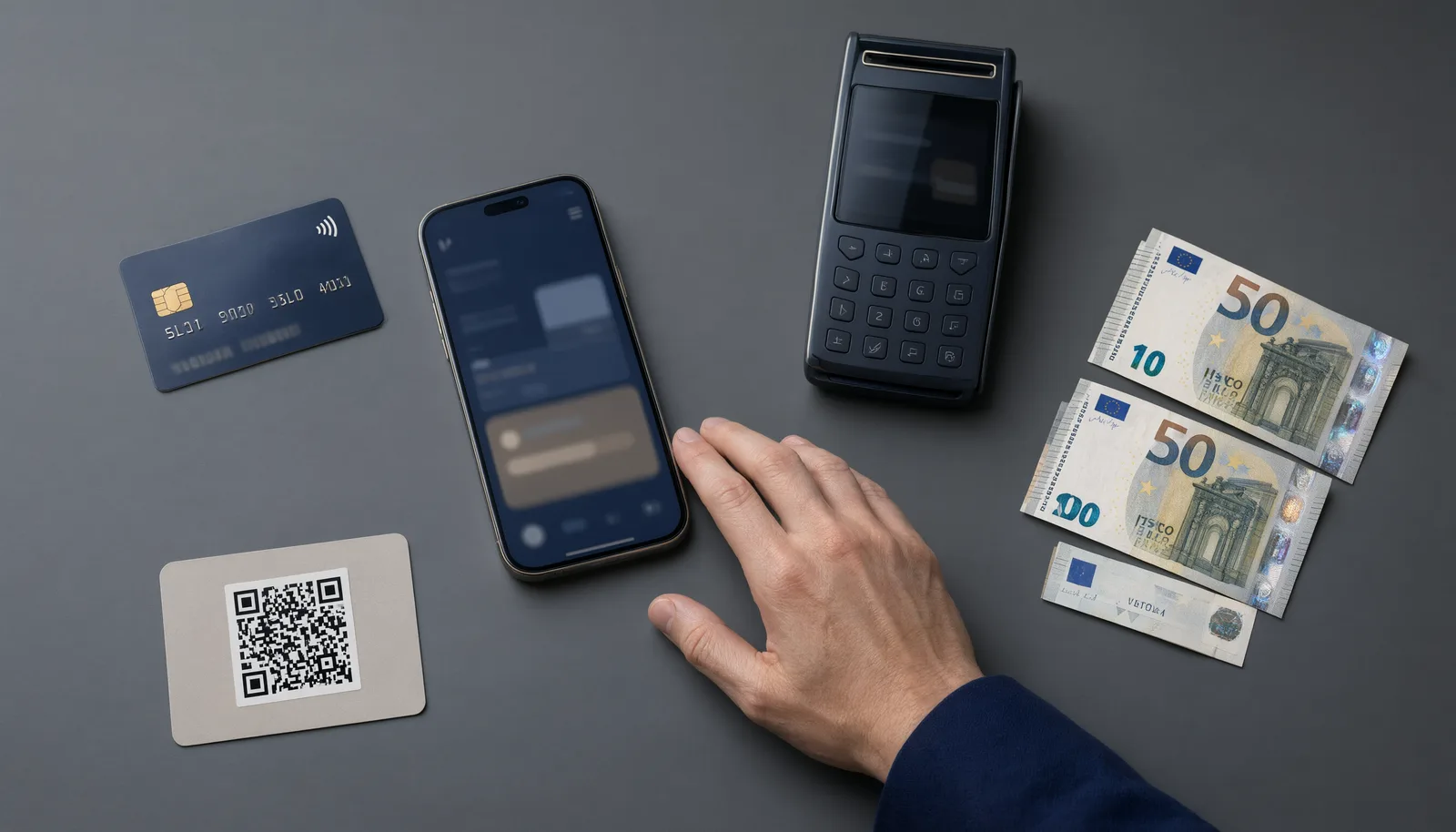
Payment Methods Compared: Times and Use Cases
| Method | Typical timing | Best for |
|---|---|---|
| Credit and debit cards | merchant settlement in 1-2 business days | retail, hospitality, e-commerce, hotels |
| SEPA Direct Debit (CORE and B2B) | execution in 1-2 business days, recurring cycle | subscriptions, utilities, recurring B2B |
| SEPA instant bank transfer | settlement within 10 seconds, 24/7/365 | e-commerce, urgent services, B2B |
| Digital wallets (Apple Pay, Google Pay) | same as cards or in real time | mobile retail, hospitality, low amounts |
| BNPL (instalment payments) | merchant paid in full upfront, customer pays in instalments | e-commerce with higher average tickets |
Indicative timings of European networks and schemes (SEPA Instant, Regulation (EU) 2024/886; SEPA schemes by the European Payments Council). Contractual settlement times depend on the payment provider.
Credit and debit cards: the baseline no business can ignore
Cards remain the dominant payment method in Europe and the mandatory starting point for any business. Every card transaction generates three separate costs: the interchange fee collected by the cardholder's bank, the scheme fee retained by Visa or Mastercard, and the markup of the provider processing the payment. Regulation (EU) 2015/751 (the Interchange Fee Regulation) caps interchange at 0.2% for consumer debit cards and 0.3% for consumer credit cards, but the markup added on top varies from provider to provider and is the main cost item a business can actually control.
With IC++ pricing like RoxPay's (€0.15 + from 0.35% to 0.85% per transaction), the invoice separates the real interchange, the scheme fee and the markup, so you know exactly what you pay for each card type. Prepaid and business cards, which are not covered by the IFR caps, can carry interchange above 2%: one more reason to prefer transparent IC++ pricing over blended percentages. For a detailed technical and economic breakdown, read our guide to payment gateway integration.
SEPA Direct Debit: the standard for subscriptions and recurring B2B
SEPA Direct Debit lets you pull funds directly from the customer's bank account with a mandate signed once, and it is the reference method for subscriptions, school fees, utilities and recurring B2B invoicing. The scheme comes in two variants with very different refund rules: under SDD CORE, a consumer payer can request a refund from their bank within 8 weeks of the debit, without giving a reason; under SDD B2B, reserved for business payers, the right to a refund does not exist once the payer's bank has validated the mandate, a meaningful protection for anyone collecting from companies.
The operational limit of the method is the slow cycle: the debit must be scheduled with a few days' notice and execution follows banking business days, so it is not suitable for collections that require immediate certainty. To go deeper into the two variants and their correct use cases, read our guide to SEPA direct debit.
Instant bank transfer and account-to-account payments: what changes at checkout
The SEPA instant transfer settles funds within 10 seconds, 24 hours a day, 7 days a week, weekends and holidays included. Since January 2025, Regulation (EU) 2024/886 requires euro area banks to make incoming and outgoing instant payments available at the same price as ordinary transfers: the historical barrier of surcharged fees has fallen by law. For a business this opens two distinct uses: collecting with immediate certainty (the customer pays from their home banking and funds arrive in seconds) and building an account-to-account checkout, where the customer authorises the transfer directly on the payment page via open banking, without typing IBAN and amounts.
RoxPay charges zero fees on instant transfers, which makes this method interesting for medium-high amounts where card percentages weigh the most. For the full picture on costs, limits and regulation read our guide to instant bank transfers for business, and for the open banking checkout model the guide to pay by bank.
Digital wallets and BNPL: the methods that drive mobile conversion
Digital wallets such as Apple Pay and Google Pay store a tokenised version of the card on the phone: at checkout the customer authorises with a fingerprint or face recognition, and the transaction travels on the card networks with the same cost structure, but with higher conversion rates because manual data entry disappears. National wallets follow a different model, based on the customer's account with direct debit or a prepaid balance; in Italy, Satispay is the main example, widespread in retail and hospitality. BNPL (Buy Now Pay Later) lets the customer pay in instalments while the merchant collects the full amount immediately: the cost is a higher commission than cards, but the documented effect is a larger average basket on higher-value products.
RoxPay supports integrating these methods alongside cards and transfers under a single contract. For details on how instalments work read our guide to buy now pay later. If you are still evaluating providers overall, our guide to choosing a payment gateway walks through the full decision process.
How to choose the right mix for your business
The right mix depends on three variables: the sales channel (physical store, e-commerce or both), the collection model (one-off transactions or recurring) and the average ticket. A business with recurring revenue needs SEPA direct debit as its backbone, an e-commerce store needs cards and wallets with instant transfer as the money-saving alternative, a physical store needs contactless cards and SoftPOS. The operational rule is to cover at least 90% of your customers' preferences without diluting the margin on methods that are too expensive for your ticket size.
Frequently Asked Questions
Which payment methods should an e-commerce accept in Europe?
The bare minimum is credit and debit cards plus a wallet (Apple Pay or Google Pay), because together they cover most European consumers. On top of that it is worth adding the instant bank transfer, which under Regulation (EU) 2024/886 costs the same as an ordinary transfer and settles in 10 seconds, and BNPL if your average ticket is in the hundreds of euros or more.
How much do payment methods cost compared to cards?
Cards carry a composite cost: interchange (capped by EU Regulation 2015/751 at 0.2% for consumer debit and 0.3% for consumer credit), scheme fee and provider markup. With IC++ pricing like RoxPay's, €0.15 + from 0.35% to 0.85%, every component is visible on the invoice. Instant transfers carry zero fees with RoxPay, and SEPA direct debit usually has fixed per-collection fees independent of the amount.
What is the difference between SEPA Direct Debit CORE and B2B?
SDD CORE targets consumers and gives the payer the right to a refund within 8 weeks of the debit. SDD B2B is reserved for business payers and, once the payer's bank has validated the mandate, there is no refund right: this is why it is the preferred scheme for companies collecting recurring invoices from other businesses.
You might also like
High Risk Payment Gateway
Secure payment processing for high-risk industries with multi-acquirer routing and chargeback protection.
Small Business Payment Solutions
Transparent IC++ pricing, free Smart POS terminal, and 24-hour activation for small businesses.
E-commerce Payment Integrations
One-click plugins for WooCommerce, Magento, and PrestaShop with full API access.
Optimize your payments today
Still unsure which payment gateway to choose? The RoxPay team helps you find the right solution for your business. Contact us at /en/contact.
✓ No monthly fixed costs · ✓ Activation in 24 hours · ✓ Dedicated technical support